


Have you ever started the day feeling comfortable, only to find your waistband digging in by teatime? You are certainly not alone. Bloating can be linked to gas, constipation, the way we eat, gut sensitivity, stress and hormonal shifts. The good news is that understanding your own patterns can be more helpful than declaring war on every food you love.
Summary
- Why am I always bloated? Bloating can be linked to gas, constipation, the way we eat, gut sensitivity, stress and hormonal shifts.
- Gas is a normal part of digestion, not a sign that your gut is doing something wrong.
- Constipation is a particularly common missing piece. You do not have to go several days without a bowel movement to experience it.
- Before putting a favourite food on the naughty list, look at the whole picture. Cutting out foods without a clear reason can also mean losing valuable fibres and nutrients.
- See your GP if your bloating lasts three weeks or more, keeps coming back, or comes with weight loss, blood in your poo, a lump in your tummy, or a change in your bowel habits.
In this guide
- Why do I look pregnant by the evening?
- Why your stomach feels heavy and bloated
- Why do I bloat after eating?
- Could hormones be playing a part?
- Why your 40s can change the picture
- Stress and the gut-brain connection
- When you have tried cutting everything out
- Start with what you can observe
- References
Have you ever started the day feeling comfortable, only to find your waistband digging in by teatime? You are certainly not alone. Bloating can be linked to gas, constipation, the way we eat, gut sensitivity, stress and hormonal shifts. The good news is that understanding your own patterns can be more helpful than declaring war on every food you love.
Why do I look pregnant by the evening?
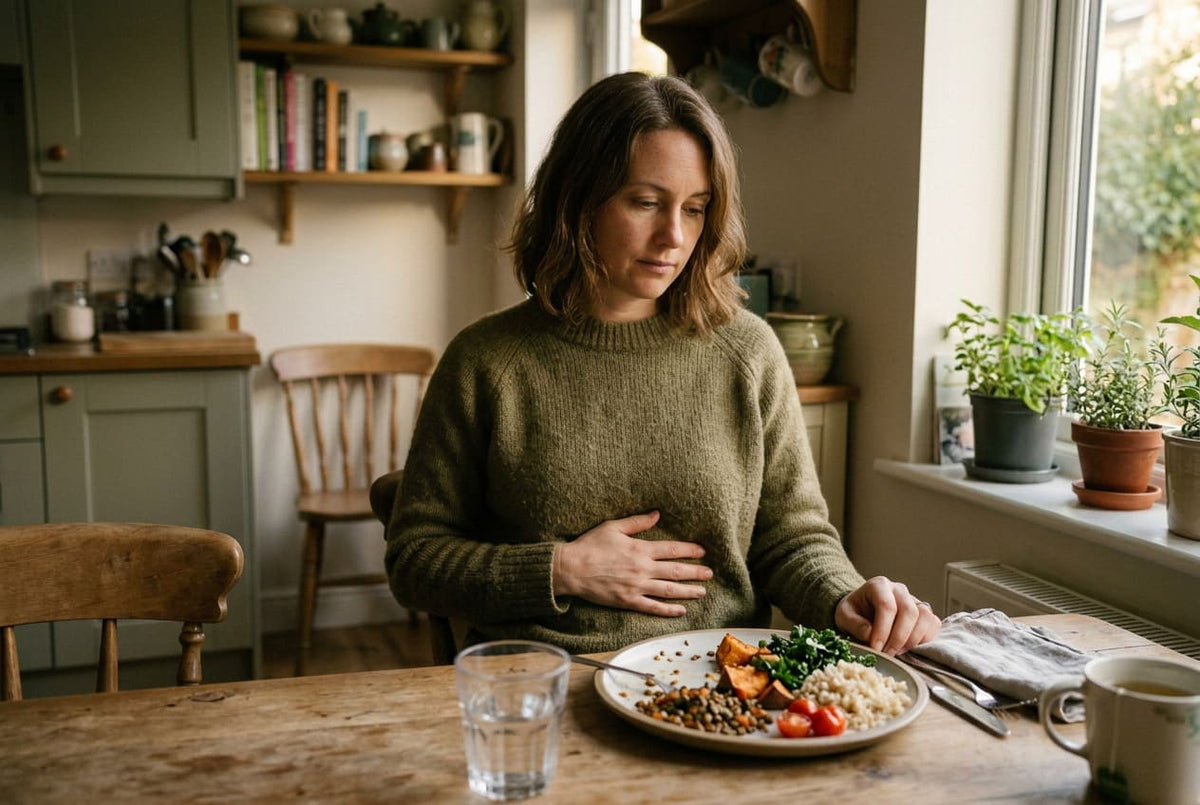
One minute your jeans fit perfectly; by the evening you are reaching for the loosest trousers you own. For some women the tummy visibly swells, while for others it is more of a heavy, stretched feeling. Either way, bloating can really get in the way of feeling like yourself.
Clinicians distinguish bloating, the sensation of pressure or fullness, from distension, an actual increase in abdominal size. They often occur together but not always. Research on disorders of gut-brain interaction shows that symptoms can reflect the way the bowel senses normal stretching and how the abdominal muscles respond. This is why a normal scan or blood test does not automatically validate your experience. It also does not mean persistent swelling should be assumed harmless.
Why your stomach feels heavy and bloated
Your gut is home to an extraordinary ecosystem of microbes. When they get to work breaking down fibres and carbohydrates in the large bowel, they naturally produce gas. That is a normal part of digestion, not a sign that your gut is doing something wrong. Discomfort can happen when gas is slow to move through, constipation gets in the way or your gut is especially sensitive to stretching.
Constipation is a particularly common missing piece. You do not have to go several days without a bowel movement to experience it. Hard stools, straining or a sense of incomplete emptying may all matter. Some medicines and changes in activity can contribute. Regularity is personal, so pay attention to changes in your own pattern rather than comparing yourself with someone else.
Other causes include swallowed air, large meals and abdominal muscle responses. Occasionally, bloating has a medical cause that needs investigation. This is why the pattern, duration and any accompanying symptoms are as important as the feeling itself.
Why do I bloat after eating?
Eating naturally stretches the stomach and sets the intestines moving. Later, bacteria ferment food components that have not been absorbed higher up. Foods such as onions, garlic, beans, wheat products and some fruits contain fermentable carbohydrates that can produce more gas in susceptible people. Fizzy drinks add gas directly, while eating in a hurry may mean swallowing extra air.
Before putting a favourite food on the naughty list, look at the whole picture. Portions, combinations of foods, bowel habits and stress can all influence how you feel. Try slowing down, sitting to enjoy meals and seeing whether a big late dinner feels different from smaller, regular meals. If one food consistently causes trouble, a dietitian can help you investigate without losing unnecessary variety.
Low-FODMAP diets can help some people with diagnosed IBS, but they are structured, time-limited approaches involving reintroduction, ideally guided by a qualified dietitian. They are not a recommendation to remove large food groups indefinitely.
Could hormones be playing a part?
Many women notice that their digestion changes through the menstrual cycle. Bloating may increase before a period, around ovulation or during bleeding. Hormone fluctuations can influence bowel movement, fluid balance and sensitivity, although not every woman follows the same pattern. Recording symptoms alongside cycle dates may help distinguish a recurring pattern from symptoms that appear at random.
Why your 40s can change the picture
Perimenopause can arrive with familiar symptoms such as hot flushes and disrupted sleep, but some women first notice changes in digestion. Shifting hormones, stress, sleep and bowel habits may all play a part. It is difficult to separate these influences, and research has not established one universal menopause-bloating mechanism.
If your gut used to feel predictable and now seems different, keep a short record of bowel changes, menstrual changes and symptoms. Discuss ongoing bloating with your GP, particularly if it is persistent rather than clearly cyclical.
Stress and the gut-brain connection
Your gut and brain are always talking. Nerves, hormones and immune signals carry messages in both directions, which helps explain why a stressful day can sometimes show up in your tummy. Stress can change how quickly food moves through the gut and how strongly you feel normal digestive sensations. The symptoms are physical, even when stress plays a part.
When you are worried about needing the toilet, eating out or wearing fitted clothes, the worry itself can become part of the daily burden. Regular meals, time outdoors, gentle movement and adequate sleep can help create a steadier routine, although they are not a substitute for investigating new symptoms.
When you have tried cutting everything out
When bloating becomes a regular visitor, eating can start to feel like a guessing game. First bread goes, then dairy, then beans, until your plate looks less colourful and mealtimes become more stressful. Sometimes a specific dietary change is useful, but cutting out foods without a clear reason can also mean losing valuable fibres and nutrients.
We love a colourful plate at microbz, and so do many of the microbes that call our gut home. Different plants provide different fibres for microbes to work with. Of course, every microbiome is unique and more diversity is not a magic guarantee of good health. The aim is to enjoy as much variety as your gut comfortably allows, not to force foods that make you feel unwell.
Our philosophy at microbz is simple: work with nature and look after the microbial world within you. microbz revive is our living, fermented liquid culture made with 15 microbial strains for an everyday gut-care routine. It is not a treatment for persistent bloating or a diagnosed digestive condition, and it should never replace medical advice.
Start with what you can observe
Rather than changing everything overnight, become a bit of a detective about your own gut. For two weeks, jot down when symptoms appear, what you eat, bowel movements, stress and, if relevant, your cycle. Make time to eat, sip water through the day, enjoy movement and increase fibre gradually if it suits you. If constipation is part of the picture, discuss suitable changes with a pharmacist, GP or dietitian.
A manageable routine is more informative than changing everything at once. Remember that you do not need to earn the right to seek medical advice by first trying every lifestyle trick on the internet. See your GP if your bloating lasts three weeks or more, keeps coming back, or comes with weight loss, blood in your poo, a lump in your tummy, or a change in your bowel habits.
References
- NHS (2025) Bloating. https://www.nhs.uk/symptoms/bloating/
- NICE (2017, updated) Irritable bowel syndrome in adults: diagnosis and management (CG61). https://www.nice.org.uk/guidance/cg61
- Lacy, B.E. et al. (2021) ACG Clinical Guideline: Management of Irritable Bowel Syndrome. American Journal of Gastroenterology, 116(1), pp.17–44. https://doi.org/10.14309/ajg.0000000000001036
- Vasant, D.H. et al. (2021) British Society of Gastroenterology guidelines on the management of irritable bowel syndrome. Gut, 70, pp.1214–1240. https://doi.org/10.1136/gutjnl-2021-324598
- Simrén, M. et al. (2013) Intestinal microbiota in functional bowel disorders: a Rome foundation report. Gut, 62, pp.159–176. https://doi.org/10.1136/gutjnl-2012-302167
- Bharucha, A.E., Pemberton, J.H. and Locke, G.R. (2013) American Gastroenterological Association technical review on constipation. Gastroenterology, 144(1), pp.218–238. https://doi.org/10.1053/j.gastro.2012.10.028
- Halmos, E.P. et al. (2014) A diet low in FODMAPs reduces symptoms of irritable bowel syndrome. Gastroenterology, 146(1), pp.67–75. https://doi.org/10.1053/j.gastro.2013.09.046