
The future of cleaning isn’t sterile. It’s alive.
For decades, we’ve been taught that a clean home is a sterile home. We’ve been taught to kill all germs, eliminate 99.9% of bacteria, and that bleach is your friend.
But what if that idea is fundamentally flawed? What if the healthiest homes aren’t the cleanest in the traditional sense, but the most biologically balanced?
Welcome to the world of probiotic cleaning.
The invisible environment you live in
We tend to think of our homes as safe spaces. They are controlled and protected because they are clean. However, the reality is more complex. Research from environmental health bodies shows that indoor air can be between 2 and 5 times more polluted than outdoor air and in some cases up to 10 times worse.
Much of this comes from what we bring into the home: cleaning sprays, air fresheners, synthetic furnishings, and plastics. Many of these release volatile organic compounds (VOCs) gases that linger in enclosed spaces and build up over time. Large-scale studies, including those published in The Lancet Planetary Health, have linked higher indoor VOC exposure to increased risks of:
- Asthma
- Chronic respiratory irritation
- Headaches and fatigue
And this exposure isn’t occasional. It’s daily. At the same time, there is something else we rarely think about; the living ecosystem in our homes.
Every surface in your home hosts a microbial ecosystem. In fact, studies estimate that a single square metre of indoor surface can contain millions of microorganisms, forming dynamic communities that shift throughout the day depending on how we live.
The question is no longer whether microbes are present.
The question is: what kind of environment are we creating for them?
The problem with “killing everything”
Traditional cleaning is built on a simple idea: remove the dirt, kill the germs, start fresh.And in certain situations, like the surgical table, that approach is essential.
But as a daily philosophy, it comes with trade-offs.
When you strip a surface back to zero, you don’t create lasting cleanliness. You create emptiness. A biological vacuum. Nature fills vacuums quickly.
Studies of indoor environments show that microbial communities can begin to re-establish within hours of cleaning, often influenced more by air, human contact and pets than by the cleaning method itself. Which means the idea of “99.9% of germs killed” is only ever temporary and in some cases, it may create instability rather than resilience.
A different philosophy: cleaning as ecology
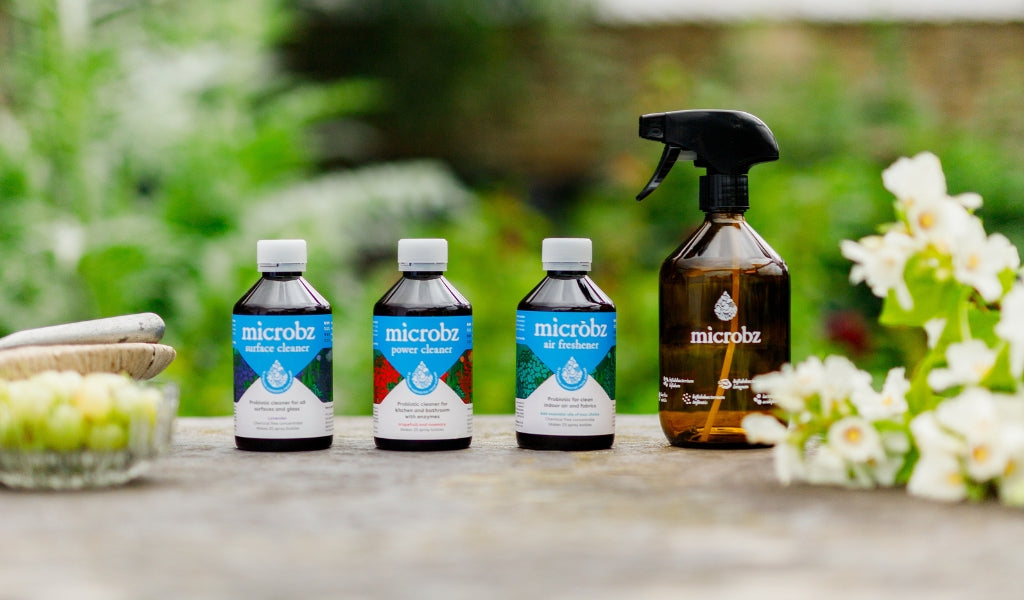
Probiotic cleaning starts from a completely different place. Instead of removing life, it introduces balance. Microbial cleaning systems use non-pathogenic bacteria that produce enzymes capable of breaking down organic matter like fats, proteins and residues that conventional cleaners often just move around.
But the real shift is not just what they remove. It’s what they leave behind.
Because these organisms continue working after application, sometimes for up to 72 hours or more, they create a more stable microbial presence on surfaces.
This leads to a concept known as competitive exclusion, where beneficial microbes occupy space and resources, making it harder for harmful bacteria to establish themselves. It’s not about elimination. It’s about ecological dominance through balance.
What the science is beginning to show
This approach is gaining traction in research settings. Clinical studies in Europe have explored probiotic cleaning systems in hospitals, arguably some of the most challenging microbial environments. These studies found that surfaces treated with beneficial bacteria showed significant reductions in common pathogens over time compared to traditional chemical cleaning alone.
At the same time, scientists are raising concerns about the overuse of disinfectants.The World Health Organization has identified antimicrobial resistance as one of the top global health threats, and research suggests that widespread exposure to disinfectants, particularly compounds like quaternary ammonium (“quats”), may contribute to microbial adaptation and resistance.
There is also increasing focus on biofilms, the protective layers bacteria build around themselves. These structures can be up to 1,000 times more resistant to chemical cleaning, according to microbiology research, which helps explain why odours and contamination often return so quickly after conventional cleaning. Enzyme-producing microbes, however, are able to break these structures down at their source.
The microbes in your environment interact constantly with your body. Research into the “built environment microbiome” shows that the diversity of microbes in indoor spaces can influence immune function, inflammation and even susceptibility to allergies.
Why this shift to probiotic cleaning happening now
The UK cleaning market is worth nearly £7 billion, but the fastest-growing segment is natural and eco-friendly cleaning which is expanding at around 12% per year. Within that, probiotic cleaning is one of the fastest-rising categories.
This is because awareness is changing. Customers are starting to question not just whether something works, but how it works, and if it impacts their health in the long term.
There is also growing awareness of chemical exposure. Studies have shown that regular use of certain cleaning products can be associated with lung function decline comparable to smoking a small number of cigarettes per day over time in occupational settings. This doesn’t mean cleaning is dangerous. But it does mean the way we clean matters.
A more balanced way to clean
There will always be moments where targeted disinfection is necessary. But for everyday cleaning, for the spaces we live in, breathe in, raise families in, the goal doesn’t need to be sterility. It can be balance.
When people switch to probiotic cleaning, they often notice something subtle. Not just how their home looks, but how it feels. Our customer report feeling good about using less harsh chemicals and they feel their indoor environments are fresh.
For a long time, we believed that health came from removing life. Now we are beginning to understand that it comes from restoring it.
And when you see your home not as something to sterilise, but as something to nurture, cleaning becomes something very different.
References
Caselli, E., D’Accolti, M., Vandini, A., Lanzoni, L., Camerada, M.T., Coccagna, M. and Mazzacane, S. (2016) ‘Impact of a probiotic-based cleaning intervention on the microbiota ecosystem of hospital surfaces: a multicentre study’, PLOS ONE, 11(9), e0159058. Available at: https://journals.plos.org/plosone/article?id=10.1371/journal.pone.0159058 (Accessed: 26 March 2026).
Caselli, E., D’Accolti, M., Soffritti, I., Lanzoni, L., Bisi, M., Volta, A. and Mazzacane, S. (2019) ‘Controlling hospital-acquired infections through probiotic-based sanitation: a review’, Microbial Biotechnology, 12(5), pp. 744–759. Available at: https://sfamjournals.onlinelibrary.wiley.com/doi/full/10.1111/1751-7915.12768 (Accessed: 26 March 2026).
European Respiratory Society (2018) ‘Cleaning products and respiratory health: longitudinal study’, European Respiratory Journal, 51(6), 1702012. Available at: https://erj.ersjournals.com/content/51/6/1702012 (Accessed: 26 March 2026).
Logue, J.M., McKone, T.E., Sherman, M.H. and Singer, B.C. (2011) ‘Hazard assessment of chemical air contaminants measured in residences’, Indoor Air, 21(2), pp. 92–109. Available at: https://doi.org/10.1111/j.1600-0668.2010.00683.x (Accessed: 26 March 2026).
National Institutes of Health (NIH) (2010) ‘Biofilms: microbial life on surfaces’, NIH Public Access. Available at: https://www.ncbi.nlm.nih.gov/pmc/articles/PMC2963962/ (Accessed: 26 March 2026).
Nature Reviews Endocrinology (2020) ‘Endocrine-disrupting chemicals: an Endocrine Society scientific statement’, Nature Reviews Endocrinology, 16, pp. 45–67. Available at: https://www.nature.com/articles/s41574-019-0273-8 (Accessed: 26 March 2026).
Prussin, A.J. and Marr, L.C. (2015) ‘Sources of airborne microorganisms in the built environment’, Nature Reviews Microbiology, 13, pp. 699–710. Available at: https://www.nature.com/articles/nrmicro.2015.7 (Accessed: 26 March 2026).
Svanes, Ø., et. al., (2018) ‘Cleaning at home and at work in relation to lung function decline and airway obstruction’, The Lancet Planetary Health, 2(7), pp. e301–e310. Available at: https://www.thelancet.com/journals/lanplh/article/PIIS2542-5196(18)30114-9/fulltext (Accessed: 26 March 2026).
World Health Organisation (WHO) (2022) Antimicrobial resistance. Available at: https://www.who.int/news-room/fact-sheets/detail/antimicrobial-resistance (Accessed: 26 March 2026).
World Health Organisation (WHO) (2023) Endocrine disruptors. Available at: https://www.who.int/news-room/fact-sheets/detail/endocrine-disruptors (Accessed: 26 March 2026).
Frontiers in Microbiology (2021) ‘Disinfectant resistance and microbial adaptation’, Frontiers in Microbiology, 12, 652632. Available at: https://www.frontiersin.org/articles/10.3389/fmicb.2021.652632/full (Accessed: 26 March 2026).
Statista (2026) Household cleaners market revenue in the United Kingdom. Available at: https://www.statista.com/outlook/cmo/home-laundry-care/household-cleaners/united-kingdom (Accessed: 26 March 2026).


