
New research from the Royal Agricultural University reveals promising results
Summary
- A Royal Agricultural University dissertation compared microbz microbial soil treatments with synthetic and organic fertilisers on wheat.
- Wheat treated with microbz grew to a similar early height as wheat given conventional fertilisers.
- microbz treatments kept a soil pH pattern close to untreated soil, unlike the synthetic fertiliser.
-
This was a 14 week pot trial measuring early growth, not yield. Field trials are the next step.
An independent Royal Agricultural University dissertation has found that microbz microbial treatments supported wheat growth comparable to conventional fertilisers in a controlled experiment, opening up exciting possibilities for the future of biological farming.
For decades, modern agriculture has focused on feeding plants through the application of fertilisers. This approach has helped farmers achieve remarkable productivity, but it has also created a growing dependence on external inputs, often at a cost to the natural processes that keep soils healthy.
What if we could achieve productive crops by working more closely with the biology already present in our soils?
A new piece of research led by Amber Casey compared microbz soil and foliar treatments with conventional synthetic and organic fertilisers. The results show that wheat treated with microbz achieved similar early growth to wheat receiving conventional fertilisers, despite differences in soil nitrate concentrations and pH. While further field research is needed, these findings offer an encouraging starting point for understanding how natural microbial solutions could become part of a more sustainable approach to farming.
Why soil biology matters for the future of farming
Soil is much more than a medium for holding plant roots. It is one of the most complex living ecosystems on Earth, containing communities of bacteria, fungi and other microorganisms that carry out essential functions. These microbes are responsible for processes that support productive agriculture, including breaking down organic matter, cycling nutrients and contributing to soil structure. They also interact directly with plant roots, helping influence the availability of nutrients within the soil. (You can read more about what soil microbes do.)
For much of the last century, agricultural productivity has been driven by the addition of synthetic nitrogen, phosphorus and potassium. These nutrients are essential for plant growth, and conventional fertilisers remain an important part of modern food production. However, fertilisers are only one part of the picture.
A soil can contain nutrients without necessarily having the biological processes needed to cycle and make those nutrients available efficiently. Over time, intensive agricultural practices can also affect microbial diversity, soil structure and the ability of the soil to function as a healthy ecosystem.
This is why scientists are increasingly investigating how soil biology could help farmers make better use of nutrients, reduce unnecessary inputs and maintain productivity.
Putting microbz to the test: comparing microbial soil treatments with fertilisers
Amber Casey's research at the Royal Agricultural University set out to investigate a practical question: Could microbz microbial treatments support wheat growth comparable to conventional fertilisers, while influencing soil health differently?
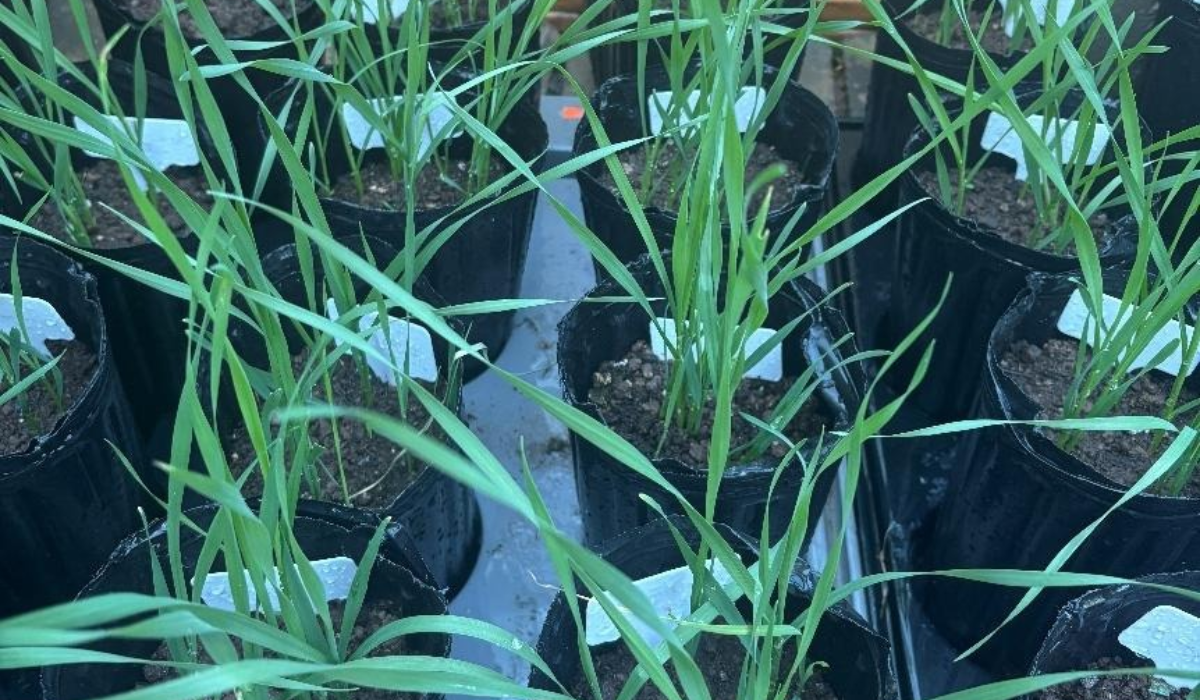
The study used agricultural soil collected from a farm in Warwickshire and grew Crusoe wheat in a controlled pot experiment over 14 weeks.
Five treatment groups were compared:
- Control: No fertiliser or microbial amendment.
- Synthetic fertiliser: A conventional nitrogen-based fertiliser.
- Organic fertiliser: Chicken manure.
- microbz soil: A microbial treatment applied below the soil surface, using microbz soil.
- microbz foliar: A microbial treatment applied to the soil surface and subsequently to the growing wheat, using microbz foliar.
Each treatment had five replicate pots, giving 25 pots in total.
The researcher monitored six indicators covering soil properties and plant performance: soil pH, nitrate concentration, organic matter, soil moisture, seedling emergence and final flag leaf height.
Soil health cannot be measured by crop growth alone. Changes in soil chemistry, moisture and biological conditions can provide important information about how agricultural treatments interact with the wider soil ecosystem. The study also compared two different ways of applying microbz, allowing the researcher to investigate whether the method of application influenced the results.
Five important findings from the microbz wheat study
1. Wheat treated with microbz showed similar early growth to fertilised wheat
One of the most encouraging findings was that wheat receiving microbz treatments grew to a similar height to wheat receiving conventional fertilisers. In fact, the microbz foliar group recorded the tallest average flag leaf height, with the microbz soil group close behind.

However, the differences between treatment groups were not statistically significant (p = 0.139). This means the study did not establish that any treatment produced better plant growth than another.
What it did show was that, under the conditions of this experiment, there was no statistically detectable disadvantage in early wheat growth from using microbz rather than conventional fertilisers. This suggests that biological amendments deserve further investigation as part of integrated nutrient management systems.
Importantly, the wheat was harvested before maturity because the plants were becoming restricted by the pots. The study therefore measured early growth, not final grain yield or crop quality.
2. microbz kept soil pH similar to untreated soil
Soil pH influences how nutrients behave in the soil and how available they are to plants. In the experiment, the soil began with an average pH of 6.31, but by the end of the study the synthetic fertiliser group showed a small decrease in pH, while the control, organic and both microbz groups showed increases.
The overall differences between treatments were statistically significant (p = 0.021). The microbz treatments followed a similar pattern to the untreated soil, whereas the synthetic fertiliser affected soil pH differently.
Soil acidity can influence nutrient availability and the long-term management needs of agricultural land. Nitrogen-based fertilisers can contribute to acidification through processes such as nitrification, which releases hydrogen ions into the soil.
The findings do not prove that microbz prevents soil acidification or improves long-term pH stability. However, they show that the microbial treatments did not produce the same short-term pH response as the synthetic fertiliser in this experiment. For farmers looking to manage both crop performance and soil chemistry, this is a promising area for further research.
3. Similar wheat growth with less nitrate than synthetic fertiliser: a nitrogen use efficiency question
Nitrogen is essential for plant growth, and conventional nitrogen fertilisers provide a readily available source. However, excess nitrogen that remains in the soil can be lost through leaching, contributing to pollution of rivers and other water bodies.
The study found that the synthetic fertiliser treatment had the highest final soil nitrate concentration. The microbz foliar treatment had the second-highest mean nitrate concentration, while the microbz soil treatment and organic fertiliser had lower concentrations.
Despite these differences, there were no statistically significant differences in the measured wheat growth between treatments. This raises an interesting possibility: could biological amendments form part of a system that supports productive crops while making more efficient use of available nutrients?
Soil microorganisms are involved in the transformation and cycling of nitrogen. Rather than simply adding readily available nutrients, microbial amendments aim to support the biological processes that influence nutrient availability. The results are consistent with the potential for a different approach to nutrient management, although they do not establish that microbz improved nitrogen-use efficiency. The study did not measure plant nitrogen uptake, nutrient losses through leaching or final crop yield. These will be important questions for future trials.
4. Soil application vs foliar spray: the method made a difference
The research compared two microbz application methods: a treatment applied beneath the soil surface and a foliar treatment applied initially to the soil and later to the growing wheat. Interestingly, the two treatments produced different soil responses.
The foliar treatment recorded a higher mean nitrate concentration than the soil treatment, while differences were also observed in soil moisture. However, these changes did not translate into statistically significant differences in wheat growth. This highlights an important point about microbial agriculture: how a product is applied may influence its interaction with the soil and plants.
5. Soil health is more complicated than crop growth alone
The research also monitored organic matter and soil moisture. Organic matter increased from the initial measurements across the treatments, but the differences between treatment groups were not statistically significant. This is perhaps unsurprising over a relatively short experiment. Building soil organic matter is a gradual process, influenced by plant residues, microbial activity and the wider soil environment.
Soil moisture showed more pronounced differences. The synthetic fertiliser treatment maintained the highest average moisture readings, while the microbz soil treatment recorded the lowest average readings. Moisture also fluctuated more substantially in the microbz treatments.
These differences were statistically significant, but they should not automatically be interpreted as better or worse soil health. The findings reinforce the importance of studying soil as a whole living system.
Why microbz takes a different approach to soil biology
Many microbial agricultural products are developed around individual species or small combinations of selected microorganisms. Our approach begins with a different principle: nature works through communities.
Healthy soils contain extraordinary microbial diversity. Different microorganisms interact, compete, cooperate and respond to the changing conditions around them. These relationships help drive the natural processes that support plant growth.
Our microbial solutions originate from microorganisms collected from healthy, uncultivated soils and are multiplied through a natural fermentation process. You can read more about how we harvest and brew them.
The future of biological farming
The challenge facing agriculture is considerable. Farmers must continue producing enough food while responding to rising input costs, changing weather patterns and increasing pressure to protect soil and water resources. Synthetic fertilisers have played a vital role in improving agricultural productivity, and they remain essential in many farming systems, but there is a growing opportunity to use them more efficiently.
A biological approach to farming considers the natural processes that influence nutrient availability alongside the nutrients supplied through fertilisers. It sits naturally alongside regenerative agriculture.
This study adds to our own on-farm work, including our spring oats trial and our grassland trial with AerWorx.
You can explore the full microbz soil and arable range on our website.
Interested in partnering with us on agricultural research or field trials? Contact agri@microbz.co.uk.
Frequently asked questions about the study
Can microbial soil treatments replace fertiliser?
This study does not show that. It found similar early wheat growth between microbz treatments and conventional fertilisers in a 14 week pot trial, but it did not measure final yield. We see microbial treatments as part of an integrated approach, used alongside good nutrient management.
Did the study measure crop yield?
No. The wheat was harvested before maturity because the plants were becoming restricted by the pots, so the study measured early growth only. Yield, nitrogen uptake and nutrient losses are questions for future field trials.
How does this compare with other microbz trials?
This was an independent, controlled pot trial carried out as part of a university dissertation. Our spring oats trial followed microbz soil on a working farm through a full season. Each type of study tells us something different, which is why we want to run more field trials.
References
-
Casey, A. (2026). Evaluating the Impact of Microbial Soil Amendments on Soil Health and Plant Performance: A Comparative Study of Microbz Foliar and Sub-Soil Applications Versus Organic and Synthetic Fertilisers. Royal Agricultural University. Undergraduate dissertation.
-
Compant, S., Cassan, F., Kostić, T., et al. (2025). Harnessing the plant microbiome for sustainable crop production. Nature Reviews Microbiology, 23, 9 to 23. https://doi.org/10.1038/s41579-024-01079-1
-
Jansson, J. K., McClure, R., & Egbert, R. G. (2023). Soil microbiome engineering for sustainability in a changing environment. Nature Biotechnology, 41, 1716 to 1728. https://doi.org/10.1038/s41587-023-01932-3
-
Lehman, R. M., et al. (2015). Understanding and enhancing soil biological health: The solution for reversing soil degradation. Sustainability, 7(1), 988 to 1027. https://doi.org/10.3390/su7010988
-
Doran, J. W., & Zeiss, M. R. (2000). Soil health and sustainability: Managing the biotic component of soil quality. Applied Soil Ecology, 15(1), 3 to 11.
-
Goulding, K. W. T. (2016). Soil acidification and the importance of liming agricultural soils with particular reference to the United Kingdom. Soil Use and Management, 32(3), 390 to 399. https://doi.org/10.1111/sum.12270
-
Adeniji, A., Fadiji, A. E., Li, S., & Guo, R. (2024). From lab bench to farmers' fields: Co-creating microbial inoculants with farmers' input. Rhizosphere, 31. https://doi.org/10.1016/j.rhisph.2024.100920
-
Giller, K. E., Hijbeek, R., Andersson, J. A., & Sumberg, J. (2021). Regenerative agriculture: An agronomic perspective. Outlook on Agriculture, 50(1), 13 to 25. https://doi.org/10.1177/0030727021998063